


Can You Tell Real AI from Fake AI? A Sharestart Training Case for Building a Learning Organization

Introduction: Sharestart and the Learning Organization
At Holo Solution, we firmly believe that people are the most important asset of a company.
Every month, we hold a regular “Corporate Sharestart” activity. This is not merely an employee event, nor is it a one-way training session. Rather, it is part of our effort to create an environment where team members can learn independently, think proactively, and gain a sense of achievement through work and interaction.
When each person is able to learn autonomously, think critically, make judgments, and express their observations and ideas through sharing and communication, the organization gradually develops the ability to grow on its own. In the face of rapid changes in the external environment, a company no longer needs to rely solely on the decisions and management of a small number of people. Instead, it can continue to reshape itself through the learning, adaptation, and interaction of all its members.
We believe that an organization is alive, just like a living organism. When it becomes ill, it slowly heals. After excitement, it gradually calms down. And through repeated learning and interaction, it finds ways to keep moving forward. This is why Holo Solution continues to promote Sharestart and the practice of building a Learning Organization.
For records of each Learning Organization activity, please refer to:“Learning Organization|Corporate Sharestart”
This Sharestart Topic: Can You Tell Real AI from Fake AI?
The topic of this Sharestart session was: “Can You Tell Real AI from Fake AI?”
AI-generated images have become increasingly common in our everyday information environment. From social media and advertising visuals to news images and creative content, people may encounter AI-generated images on a daily basis. This makes it even more important for us to train our ability to observe, judge, and verify information.
Perhaps one day, AI-generated images will become almost impossible to distinguish from real photographs based on the image itself. Even so, the human ability to think independently remains irreplaceable.
We can regard AI-generated content as a type of information produced under a specific logic. Just as different people have different perspectives, values, and ways of expression, AI also generates seemingly reasonable content based on data, prompts, and model logic. What truly matters is not only whether an image was generated by AI, but whether we can classify information, extract key points, remove false or trivial details, and form a relatively reasonable conclusion.
In other words, whether an image was generated by AI or captured by a real person may not always be the most important question. The more essential questions are: What is this image trying to communicate? Has it successfully communicated that message? Do we still retain the ability to judge, verify, and think critically?
There is an old saying: “Everyone knows that a knife can kill, but not everyone understands that a pen can also kill.” Words can construct facts, but they can also create lies. Falsehoods written with a pen can harm a person, but only when readers lack the ability to gather information from multiple sources, think independently, and make their own judgments.
In the age of AI, fake images can also harm people, mislead them, and even influence collective judgment. Yet the underlying condition remains the same: if people possess independent thinking and fact-checking abilities, then even when an AI-generated image has no obvious flaws, they can still analyze the context, verify facts, compare multiple sources, and reach a more reasonable judgment.
From observing images and judging truth from falsehood to sharing observations and discussing experiences, this process closely resembles the spirit of Sharestart. In this session, we used a small game of identifying AI-generated images as a training activity for the Learning Organization. Through a relaxed and interactive process, team members practiced observation, thinking, expression, and discussion, while also strengthening the learning connections within the organization.
Learning from Cases: How to Identify Flaws in AI-Generated Images
At the beginning of the activity, the facilitator used existing examples as practice cases, guiding participants to observe possible flaws in AI-generated images.
Although current AI image-generation technology has become highly advanced, it may still leave behind unnatural details in certain areas. For example, finger proportions, body structure, object edges, lighting direction, perspective, material logic, background details, and physical plausibility may still reveal clues. With careful observation, it is still possible to identify patterns and make judgments about whether an image is real or AI-generated.
Thinking About How to Create AI-Generated Images That Are Difficult to Distinguish
After understanding common flaws in AI-generated images, the activity moved into a hands-on stage.
Participants were asked to prepare photographs they had taken themselves, then use AI tools to create another image with a similar style, composition, or subject. Afterward, everyone discussed the results and selected stronger image pairs to use as quiz questions. The facilitator then organized the materials and asked other participants to judge which image was a real photograph and which was generated by AI.
This process was not only a test of identification ability. It also allowed participants to think from the perspective of a creator: if we want an AI-generated image to look more realistic, how should the prompt or source material be designed? Which realistic features should be retained? Which details are more likely to reveal flaws?
Through this exercise, participants were not only passively judging images. They also began to understand the differences between AI generation logic and human observation logic.
Sharing Techniques for Creating Highly Realistic AI Images
Using a Real Photograph as the Basis and Changing Poses or Local Details
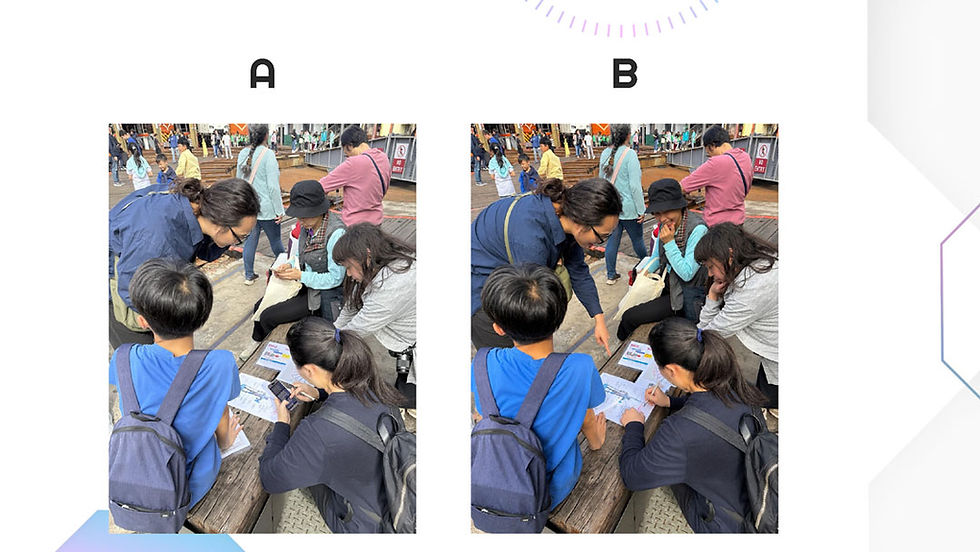
In one case, AI was asked to use real photo A as the basis and modify the subject’s pose to generate a highly realistic image B.
Because the overall scene, character appearance, and lighting conditions were close to the original photo, the AI-generated image had very few obvious flaws. However, some participants still noticed that the left hand of the person wearing dark blue clothing appeared slightly disproportionate. This shows that even when an AI image looks natural, local body structure may still contain subtle inconsistencies.
In another case, AI was asked to use real photo B as the basis and change the bird’s feathers to make them look more ruffled.
This highly realistic image had even fewer visible flaws. Compared with human photos, details of animals and plants are often more difficult for ordinary viewers to identify accurately. People are usually highly sensitive to human faces, hands, and body proportions, but when observing bird feathers, plant leaves, or natural environments, their ability to detect unreasonable details may decrease.
This reminds us that judging AI-generated images cannot rely only on whether something “looks real.” It also requires subject knowledge, life experience, and careful observation.

Sharing Methods for Identifying Flaws in AI Images
Judging Authenticity Through Physical Plausibility
In another case, image A transformed a dinosaur card into the shape of a fruit tart. At first glance, the image appeared complete. However, upon closer observation, the fruit pieces on the cake were slightly too large relative to the cake itself, and these fruit cubes would not easily form such a complete structure in reality. This revealed flaws in physical plausibility and structural logic.
This type of flaw reminds us that when judging AI-generated images, we should not only observe whether the image looks refined. We also need to consider whether the object itself follows real-world logic: whether its weight, material, proportions, support structure, and combination of elements are physically reasonable.

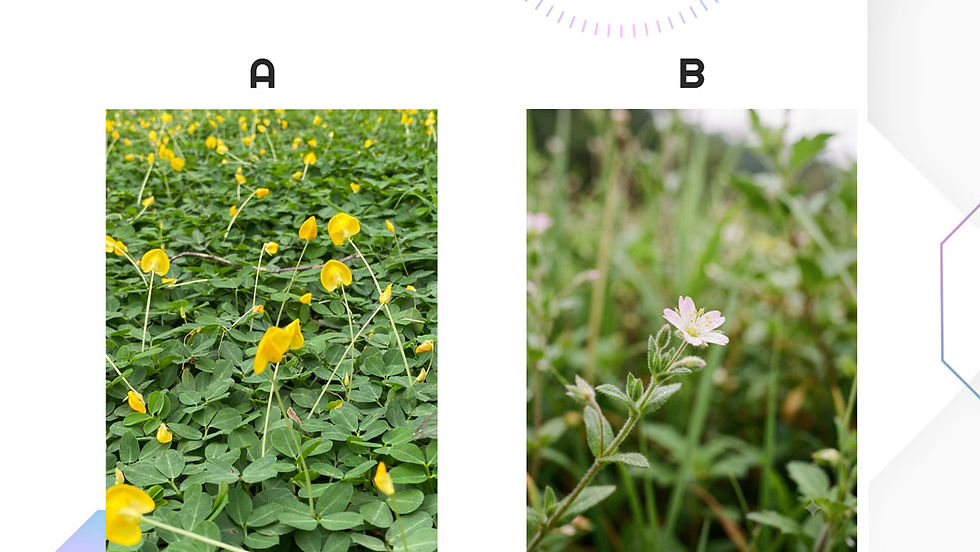
Another flower photo case was more difficult to judge. Image B was an AI-generated photo of small flowers. Without comparison, it would actually be difficult to tell whether it was real or AI-generated.
One participant made an inference based on photography experience, noting that AI often generates images with strong depth of field and heavily blurred backgrounds, while ordinary people may not frequently use this type of photographic technique in everyday shooting. Therefore, the participant inferred that image B might be AI-generated based on whether the image style appeared overly idealized.
This case also shows that flaws in AI images do not always come from obvious mistakes. Sometimes, an image that is too beautiful, too clean, or too aligned with a certain visual aesthetic can also become a clue for judgment.
The Meaning of Judging AI Authenticity for a Learning Organization
AI tools were not invented solely for forgery or deception. In fact, making it difficult to distinguish between human-created and AI-generated content has always been one of the important directions in the development of generative AI. Therefore, training the ability to judge whether an image is real or AI-generated is not about resisting the development of AI, nor is it simply about criticizing AI technology. Rather, it is about gaining a deeper understanding of AI, learning how to use it, and learning how to coexist with it.
What is the relationship between a photograph and reality?What is the relationship between an AI image and a photograph?
In an era where digital images, generative AI, and information circulation are rapidly merging, “truth” and “falsehood” may not always have a single, simple answer. The real key is whether people still possess the ability to make independent judgments.
If each person can observe information, verify facts, present their viewpoints, and share and exchange ideas with others, then the organization develops a continuous capacity for learning and self-correction. Every act of observation, discussion, questioning, and feedback becomes part of organizational learning.
From this perspective, an organization that can absorb information, exchange experience, revise judgments, and continuously evolve is like an intelligent system. Through the observation and thinking of each member, it continuously accumulates data, adjusts its understanding, and updates its actions.
This is the value of a Learning Organization.
Judging real and fake AI images may seem like a small game, but behind it lies the training of observation, judgment, expression, and organizational learning. As these capabilities continue to accumulate in everyday work, the organization gradually develops its own intelligence.


